
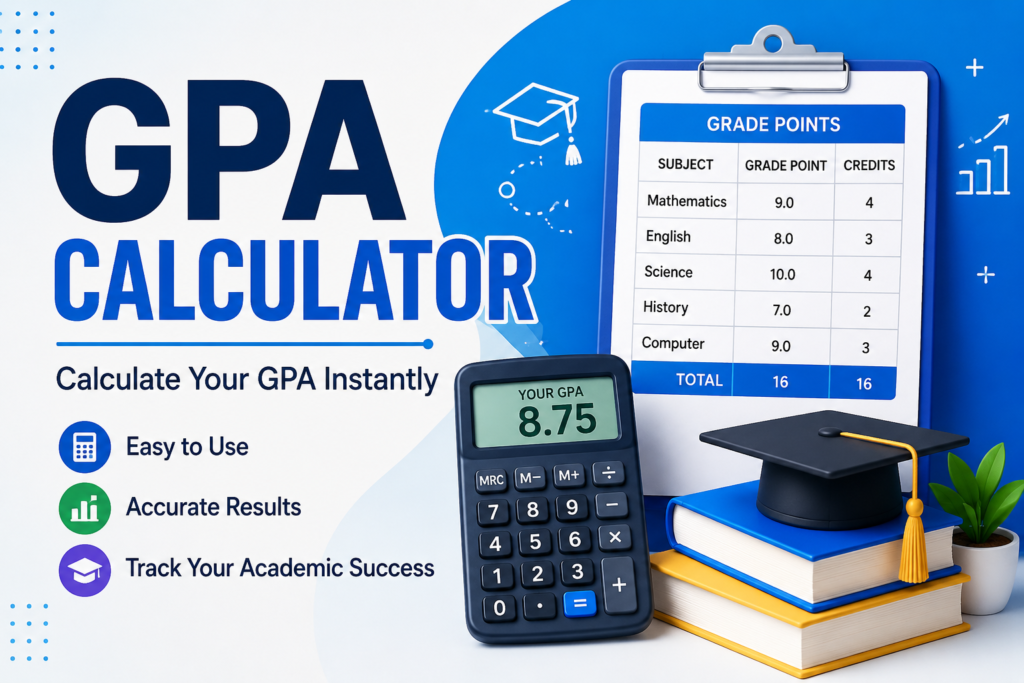
GPA Calculator
Calculate your GPA instantly
Your GPA
0.00
How to Use This GPA Calculator
Calculating your GPA is quick and easy. Follow these simple steps:
Step 1: Enter Subject Name
Type the name of each subject or course in the Subject Name field. This helps you keep track of the courses included in the calculation.
Step 2: Enter Grade Point
Input the grade point you received for each subject. Use the grading scale provided by your school, college, or university (such as a 4.0 scale or 10-point scale).
Step 3: Enter Credit Hours
Enter the number of credit hours assigned to each subject. Credit hours represent the academic weight of a course.
Step 4: Add More Subjects
Click the “Add Subject” button to include additional courses in your GPA calculation.
Step 5: Remove Unwanted Entries
If you entered a subject by mistake, click the “Remove” (✕) button next to that row.
Step 6: Calculate Your GPA
After entering all subjects, grade points, and credit hours, click the “Calculate GPA” button.
Step 7: View Your Result
Your GPA will instantly appear in the result section. The calculator automatically computes the weighted average based on the grade points and credits entered.
Example
| Subject | Grade Point | Credits |
|---|---|---|
| Mathematics | 9 | 4 |
| English | 8 | 3 |
| Science | 10 | 4 |
GPA = (9×4 + 8×3 + 10×4) ÷ (4+3+4) = 9.09
Important Notes
- Ensure all grade points and credits are entered correctly.
- GPA scales may vary between institutions.
- This calculator provides an estimate based on the information entered.
- For official GPA records, always refer to your educational institution’s grading policy.
Use this GPA Calculator to track your academic performance, set educational goals, and stay informed about your progress throughout your studies.
GPA: Meaning, Calculation, Importance, and Everything Students Need to Know
What is GPA?
GPA, or Grade Point Average, is a numerical representation of a student’s academic performance over a specific period. It is widely used by schools, colleges, and universities to evaluate how well a student has performed in their courses. GPA converts letter grades or percentage scores into a standardized point system, making it easier to compare academic achievements.
A higher GPA generally indicates better academic performance and can play an important role in college admissions, scholarship opportunities, internships, and employment prospects.
Why is GPA Important?
GPA serves as an important academic indicator for students. Educational institutions and employers often use GPA to assess a student’s consistency, dedication, and ability to perform academically.
Some key benefits of maintaining a good GPA include:
- Better chances of admission to top universities.
- Eligibility for scholarships and financial aid.
- Improved opportunities for internships.
- Enhanced job prospects after graduation.
- Qualification for academic honors and awards.
How is GPA Calculated?
GPA is calculated by dividing the total grade points earned by the total number of credit hours attempted.
GPA Formula
GPA = Total Grade Points Earned ÷ Total Credit Hours
For example:
| Course | Grade Point | Credits |
|---|---|---|
| Mathematics | 9 | 4 |
| English | 8 | 3 |
| Science | 10 | 4 |
Total Grade Points = (9 × 4) + (8 × 3) + (10 × 4) = 100
Total Credits = 4 + 3 + 4 = 11
GPA = 100 ÷ 11 = 9.09
Common GPA Scales
Different institutions use different GPA scales. The most common are:
4.0 GPA Scale
| Grade | GPA |
|---|---|
| A | 4.0 |
| B | 3.0 |
| C | 2.0 |
| D | 1.0 |
| F | 0.0 |
10-Point GPA Scale
| Grade | GPA |
|---|---|
| O | 10 |
| A+ | 9 |
| A | 8 |
| B+ | 7 |
| B | 6 |
| C | 5 |
Difference Between GPA and CGPA
Many students confuse GPA with CGPA.
GPA (Grade Point Average)
- Measures performance for a single semester or academic period.
- Calculated using grades obtained in individual courses during that period.
CGPA (Cumulative Grade Point Average)
- Represents overall academic performance across multiple semesters.
- Calculated by combining all GPA scores earned throughout the program.
Tips to Improve Your GPA
Students looking to improve their GPA can follow these practical strategies:
1. Attend Classes Regularly
Regular attendance helps students understand concepts better and stay updated with coursework.
2. Manage Your Time Effectively
Create a study schedule and prioritize important assignments and exams.
3. Focus on Weak Subjects
Identify subjects where you struggle and dedicate extra study time to improve performance.
4. Participate Actively
Engage in classroom discussions, group projects, and academic activities.
5. Seek Help When Needed
Consult teachers, tutors, or classmates whenever you face academic challenges.
GPA and Career Opportunities
While GPA is not the only factor employers consider, it often plays a significant role in the early stages of recruitment. Many organizations use GPA as a screening criterion for internships and entry-level positions.
A strong GPA demonstrates:
- Academic discipline
- Commitment to learning
- Consistency in performance
- Problem-solving abilities
Conclusion
GPA is an important measure of academic success that helps educational institutions and employers evaluate student performance. Understanding how GPA is calculated and taking steps to improve it can open doors to better educational and career opportunities. Whether you are a school student, college student, or university graduate, maintaining a strong GPA can contribute significantly to your future success.
Frequently Asked Questions (FAQs)
1. What does GPA stand for?
GPA stands for Grade Point Average, a numerical measure of academic performance.
2. How is GPA calculated?
GPA is calculated by dividing total grade points earned by total credit hours completed.
3. What is a good GPA?
A good GPA depends on the institution, but generally a GPA above 3.0 on a 4.0 scale is considered good.
4. What is the highest GPA possible?
On a standard scale, the highest GPA is usually 4.0, though some institutions use weighted scales that can exceed 4.0.
5. Is GPA important for college admissions?
Yes, GPA is one of the most important factors considered during college admissions.
6. Does GPA affect scholarships?
Many scholarship programs require students to maintain a minimum GPA.
7. What is the difference between GPA and percentage?
Percentage represents marks obtained out of 100, while GPA is a standardized grading scale.
8. What is the difference between GPA and CGPA?
GPA reflects performance for a specific semester, while CGPA reflects cumulative performance across multiple semesters.
9. Can I improve my GPA?
Yes, by achieving higher grades in future courses and maintaining consistent academic performance.
10. Is GPA used worldwide?
Many countries use GPA systems, although grading methods can vary between institutions.
11. What GPA is required for scholarships?
Requirements vary, but many scholarships require a GPA between 3.0 and 3.5 or higher.
12. How do colleges convert percentages to GPA?
Each institution follows its own conversion formula or grading scale.
13. Is a 3.5 GPA considered good?
Yes, a 3.5 GPA is generally considered very good and competitive for admissions and scholarships.
14. Does GPA matter after graduation?
For experienced professionals, GPA becomes less important over time, but it can matter for entry-level jobs and higher education applications.
15. Can failed courses affect GPA?
Yes, failed courses typically lower your GPA because they contribute fewer or no grade points.
16. How often is GPA calculated?
Usually at the end of each semester, term, or academic year.
17. What is a weighted GPA?
A weighted GPA gives additional points for advanced, honors, or AP-level courses.
18. What is an unweighted GPA?
An unweighted GPA uses the standard grading scale without additional weighting.
19. Can extracurricular activities improve GPA?
No, extracurricular activities do not directly affect GPA, though they may strengthen college applications.
20. Why do employers ask for GPA?
Employers may use GPA to assess academic achievement, discipline, and consistency, especially for recent graduates.+