
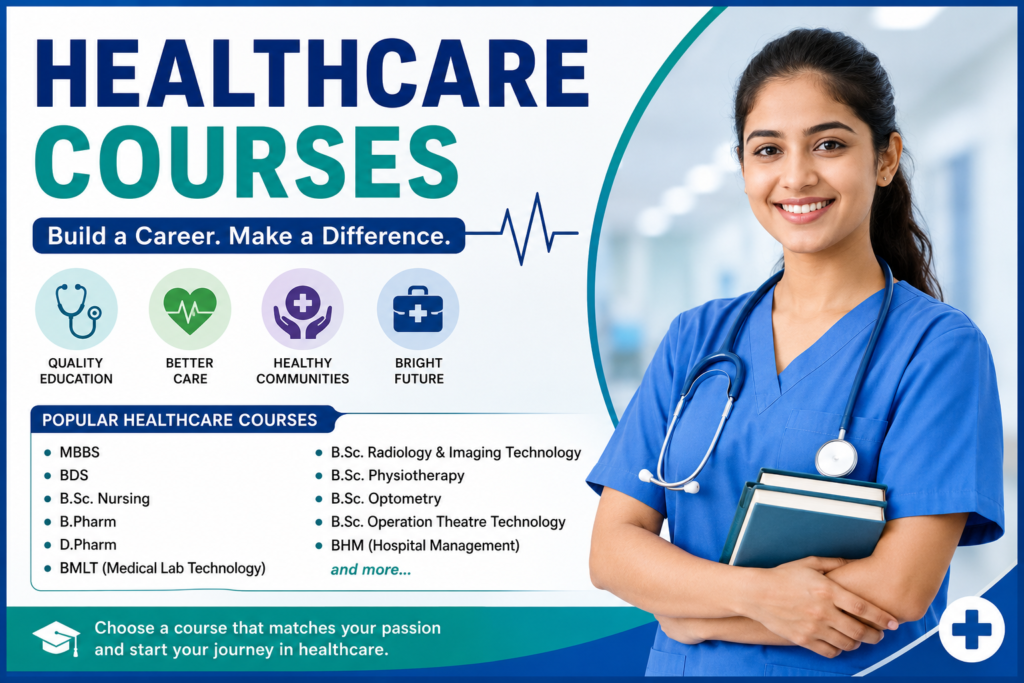
The healthcare industry is one of the fastest-growing sectors worldwide, offering excellent career opportunities for students after completing their 10+2 education. Admission to most healthcare programs in India is based on competitive entrance examinations conducted at the national, state, or university level. These exams evaluate students’ knowledge of Physics, Chemistry, Biology, Mathematics, English, and General Aptitude, depending on the course.
Whether you aspire to become a doctor, dentist, nurse, pharmacist, physiotherapist, or allied healthcare professional, understanding the available entrance examinations is the first step toward achieving your career goals.
This comprehensive guide covers the major competitive examinations for healthcare courses after Class 12, including eligibility, exam pattern, accepted courses, participating institutions, and career prospects.
Why Are Healthcare Entrance Exams Important?
Healthcare entrance examinations help institutions:
- Select deserving candidates based on merit.
- Maintain high academic standards.
- Ensure fairness and transparency in admissions.
- Evaluate students’ scientific knowledge and aptitude.
- Offer admission to government and private institutions.
List of Major Healthcare Entrance Examinations After 10+2
1. NEET UG (National Eligibility cum Entrance Test)
NEET UG is India’s largest medical entrance examination conducted annually for admission into undergraduate medical and allied healthcare courses.
- Passed 10+2Physics
- Chemistry
- Biology/Biotechnology
- English
- Minimum qualifying marks as prescribed by NMC
- Minimum age: 17 years
- MBBS
- BDS
- BAMS
- BHMS
- BUMS
- BSMS
- BVSc & AHBSc Nursing (in many institutions)
- BPT (selected colleges)
- BSc Allied Health Sciences (selected institutions)
- Doctor
- Dentist
- Ayurvedic Physician
- Homeopathic Doctor
- Veterinary Doctor
- Medical Research
- Public Health
2. AIIMS BSc Nursing Entrance Examination
Conducted for admission into BSc Nursing programmes offered by AIIMS institutions.
- 10+2 with PCB and English
- Minimum qualifying marks as prescribed
- BSc Nursing (Hons.)
- BSc Nursing (Post Basic)
- Registered Nurse
- ICU Nurse
- Operation Theatre Nurse
- Nurse Educator
- Clinical Research Nurse
3. JIPMER BSc Nursing Entrance
The Jawaharlal Institute of Postgraduate Medical Education and Research admits students to its nursing programmes through the national entrance process (admissions are generally linked with NEET or institute notifications, depending on the programme and year).
- 10+2 with PCB and English
- English compulsory
- BSc Nursing (Hons.)
- BSc NursingAllied Health Courses
- Nursing Officer
- Hospital Administration
- Community Health
4. CUET UG (Common University Entrance Test)
CUET UG is used by many central, state, deemed, and private universities for undergraduate admissions.
- 10+2
- Subject requirements depend on the university
- BSc Nursing (Hons.)
- BSc Nursing (participating universities)
- B.Pharm
- BMLT
- BMRIT
- B.Sc. Biomedical Science
- Nutrition & Dietetics
- Public HealthBiotechnology
- Nursing Officer
- Hospital Administration
- Community Health
5. ICAR AIEEA UG
ICAR AIEEA UG stands for the Indian Council of Agricultural Research All India Entrance Examination for Admission – Undergraduate. It is the premier national-level entrance exam for admission to undergraduate agriculture and allied science programs in India.
- 10+2 PCB
- Agriculture stream (where applicable)
- BVSc & AH
- Nursing Officer
- Veterinary Doctor
- Animal Healthcare Officer
- Livestock Consultant
6. State CET (Common Entrance Test)
Many Indian states conduct their own entrance examinations for healthcare courses.
- Maharashtra CET
- Karnataka CETKerala Entrance
- West Bengal Joint Entrance (selected programmes)
- Odisha OJEE
- Assam State Entrance (where applicable)
- 10+2 PCB
- Pharmacy
- Nursing
- Physiotherapy
- Allied Health Sciences
- Paramedical Courses
- Physiotherapist
- Nurse
- Others
7. University-Specific Entrance Examinations
Several reputed universities conduct their own admission tests or use national-level scores.
- Christian Medical College (CMC)
- Manipal Academy of Higher Education
- SRM InstituteKIIT University
- Amity University
- Lovely Professional University
- Symbiosis
- 10+2 PCB
- Pharmacy
- Nursing
- Physiotherapy
- Allied Health Sciences
- Paramedical Courses
- Physiotherapist
- Nurse
- Others
8. Nursing Entrance Examinations (State Level)
Many state nursing councils and universities conduct independent entrance examinations.
State Authority
- 10+2 PCB
- ANM
- GNM
- BSc Nursing
- Post Basic Nursing
- Acording to The Course
Eligibility Summary
| Examination | Minimum Qualification | Subjects Required |
| NEET UG | 10+2 | PCB + English |
| AIIMS BSc Nursing | 10+2 | PCB + English |
| CUET UG | 10+2 | Depends on Course |
| State CET | 10+2 | PCB / PCM |
| Pharmacy Entrance | 10+2 | PCB/PCM |
| Paramedical Entrance | 10+2 | PCB preferred |
| Veterinary Entrance | 10+2 | PCB |
Documents Required
Students generally need:
- Class 10 Marksheet
- Class 12 Marksheet
- Admit Card
- Passport-size Photographs
- Aadhaar Card or Valid ID
- Category Certificate (if applicable)
- PwD Certificate (if applicable)
- Domicile Certificate (where applicable)
Preparation Tips
Build Strong Fundamentals
Focus on:
- Biology
- Physics
- Chemistry
Follow NCERT
Most national examinations are heavily based on NCERT textbooks.
Practice MCQs
Solve:
- Previous year papers
- Mock tests
- Chapter-wise questions
Time Management
Create a study schedule that includes:
- Revision
- Mock tests
- Concept building
Stay Updated
Keep track of:
- Notification dates
- Application deadlines
- Admit card release
- Examination schedule
- Counselling process
Career Opportunities After Healthcare Entrance Exams
Successful candidates can pursue careers as:
- Doctor
- Dentist
- Nurse
- Pharmacist
- Physiotherapist
- Occupational Therapist
- Medical Laboratory Technologist
- Radiology Technologist
- Optometrist
- Audiologist
- Emergency Medical Technician
- Cardiac Care Technologist
- Dialysis Technologist
- Public Health Professional
- Healthcare Administrator
- Medical Researcher
Advantages of Choosing Healthcare Careers
- High employability
- Excellent salary potential
- Job security
- Opportunities in India and abroad
- Diverse specialization options
- Scope for higher education
- Meaningful contribution to society
- Growing demand for skilled professionals
Frequently Asked Questions (FAQs)
1. Which is the most important healthcare entrance exam after 10+2?
NEET UG is the most important entrance examination for students seeking admission to MBBS, BDS, AYUSH courses, and several allied healthcare programmes.
2. Is NEET compulsory for all healthcare courses?
No. While NEET is mandatory for MBBS, BDS, and AYUSH programmes, many courses such as B.Pharm, BMLT, BPT, B.Sc. Nursing (at some institutions), and other allied health programmes may admit students through CUET, state entrance exams, university-specific tests, or Class 12 merit.
3. Can PCM students apply for healthcare courses?
Yes. Students with Physics, Chemistry, and Mathematics can pursue courses like B.Pharm, Biomedical Engineering, Medical Imaging Technology (in some institutions), and other selected allied healthcare programmes. Eligibility varies by course and institution.
4. Which healthcare course has the highest salary?
MBBS followed by postgraduate specialization generally offers the highest earning potential. Other high-paying fields include Pharm.D, Physiotherapy, Radiology Technology, Cardiac Care Technology, and Clinical Research.
5. Can I pursue healthcare courses without Biology?
Yes, but your options are limited. Courses such as B.Pharm (at eligible institutions), Biomedical Engineering, and certain healthcare technology programmes may accept students with Mathematics. Always check the specific eligibility criteria of the institution.
6. What is the age limit for NEET UG?
Candidates must be at least 17 years old by the prescribed date in the admission year. There is currently no upper age limit, subject to the latest regulations.
7. Which entrance exam is best for BSc Nursing?
Admissions to BSc Nursing may be based on NEET UG, AIIMS BSc Nursing Entrance (where applicable), CUET UG, state nursing entrance exams, or university-specific admission processes, depending on the institution.
8. Which exam is required for Pharmacy?
Admission to B.Pharm may be through CUET UG, state CETs, university entrance examinations, or merit-based admissions, depending on the college. Some institutions also consider NEET scores.
9. Are government healthcare colleges better than private colleges?
Government colleges generally offer lower tuition fees and strong clinical exposure, while many private colleges provide modern infrastructure and specialized facilities. The best choice depends on accreditation, faculty, hospital affiliation, and placement opportunities.
10. How should I prepare for healthcare entrance exams?
Focus on NCERT concepts, maintain a consistent study schedule, solve previous years’ question papers, take mock tests regularly, and stay updated with official exam notifications and counselling schedules.
Final Thoughts
Healthcare entrance examinations are the gateway to rewarding careers in medicine, nursing, pharmacy, physiotherapy, veterinary science, and allied health professions. Choosing the right examination depends on your career aspirations, academic background, and preferred course. By understanding the eligibility criteria, exam patterns, and admission processes, students can make informed decisions and prepare strategically. With dedicated preparation and the right guidance, you can secure admission to a reputed institution and build a successful career in the ever-growing healthcare sector.