
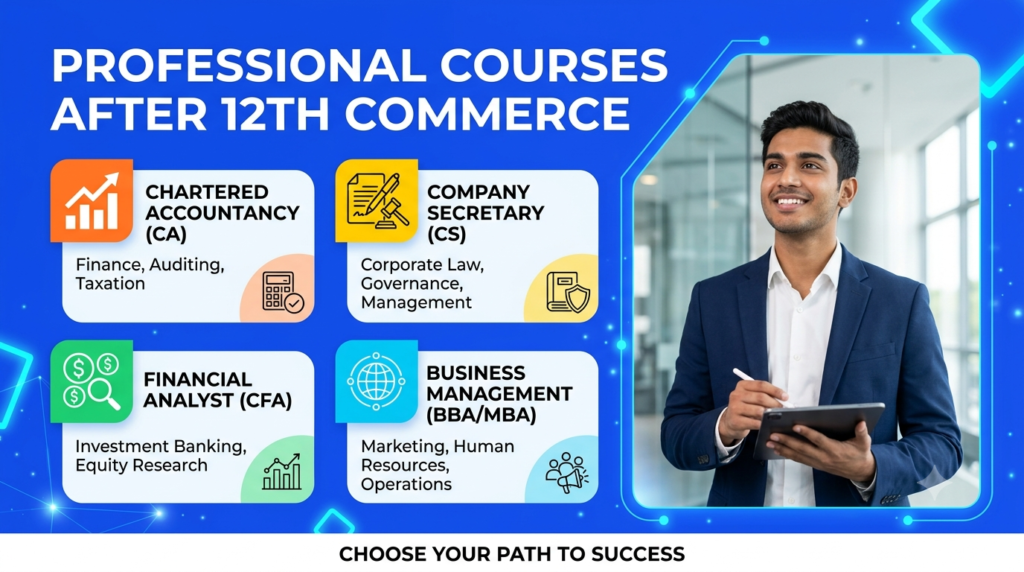
Choosing the right professional course after 12th Commerce can be one of the most important decisions for students who want to build a successful career without limiting themselves to traditional degree programs. Commerce provides a strong foundation in accounting, business, economics, finance, taxation, management, and entrepreneurship, making Commerce students eligible for a wide range of professional and career-oriented courses.
We can choose from professional courses after 12th Commerce, undergraduate degrees, diploma programs, certification courses, computer-related programs, finance courses, management programs, and specialized career pathways. The best option depends on our interests, academic background, career goals, budget, and the amount of time we want to invest in higher education.
What Are Professional Courses After 12th Commerce?
Professional courses are programs designed to develop practical, industry-oriented knowledge and job-ready skills. Unlike purely academic programs, professional courses generally focus on specific career areas such as accounting, finance, banking, taxation, business management, digital marketing, information technology, human resources, entrepreneurship, and commerce.
After completing Class 12 Commerce, we can pursue professional courses alongside or instead of a conventional degree, depending on the eligibility requirements of the program.
Some professional courses can be completed within a few months, while others require several years of education, examinations, practical training, or professional certification.
Best Professional Courses After 12th Commerce
Here are some of the most popular professional and career-oriented options for Commerce students.
1. Bachelor of Commerce (B.Com)
B.Com is one of the most popular choices after 12th Commerce. It provides comprehensive knowledge of accounting, finance, taxation, economics, business law, business communication, and management.
A B.Com degree can provide a foundation for careers in:
- Accounting
- Banking
- Finance
- Taxation
- Insurance
- Business administration
- Auditing
- Corporate services
- Government jobs
- Higher education
Students can further specialize through professional certifications, postgraduate programs, or industry-specific courses.
2. Bachelor of Business Administration (BBA)
BBA is an excellent choice for students interested in management, business operations, entrepreneurship, marketing, and corporate careers.
A BBA program commonly covers subjects such as:
- Business management
- Marketing management
- Financial management
- Human resource management
- Business communication
- Organizational behavior
- Entrepreneurship
- Business economics
Students who want to pursue management careers can later consider an MBA or other specialized management qualifications.
3. Bachelor of Computer Applications (BCA)
Commerce students who have an interest in computers and technology can consider BCA, subject to the eligibility requirements of the institution.
BCA introduces students to areas such as:
- Programming
- Database management
- Web development
- Computer applications
- Software development
- Networking
- Information systems
The combination of Commerce knowledge and technology skills can be useful for careers in business technology, software support, data-related roles, digital business, and IT services.
4. Chartered Accountancy (CA)
Chartered Accountancy is one of the most recognized professional career paths for Commerce students.
CA focuses extensively on:
- Accounting
- Auditing
- Taxation
- Financial reporting
- Corporate laws
- Financial management
- Business and economic regulations
Students interested in accounting, auditing, taxation, and financial management may consider CA as a long-term professional goal. The qualification involves structured stages and examinations, so students should understand the current eligibility and examination requirements before enrolling.
5. Company Secretary (CS)
The Company Secretary profession is suitable for students interested in corporate law, compliance, governance, and company administration.
A CS professional may work with organizations on areas such as:
- Corporate compliance
- Company law
- Corporate governance
- Legal documentation
- Regulatory requirements
- Board procedures
- Corporate administration
This can be an attractive option for students who enjoy business law and corporate regulations.
6. Cost and Management Accountancy (CMA)
CMA is another important professional pathway for Commerce students interested in accounting, cost management, financial planning, and business decision-making.
The field can involve:
- Cost accounting
- Financial management
- Budgeting
- Cost control
- Business analysis
- Management accounting
- Strategic financial planning
CMA professionals can work in manufacturing organizations, service companies, financial departments, consulting firms, and other business environments.
7. Bachelor of Economics
Students who enjoy economics, statistics, financial analysis, and economic theory can consider a bachelor’s degree in Economics, subject to institutional eligibility.
This pathway can provide a foundation for careers and further studies in:
- Economics
- Banking
- Finance
- Research
- Data analysis
- Public policy
- Business analysis
- Financial services
Students interested in economics can also pursue postgraduate study or specialized certifications later.
8. Banking and Finance Courses
Commerce students can also explore professional courses related to banking and finance.
These courses may cover:
- Banking operations
- Financial services
- Investment fundamentals
- Retail banking
- Insurance
- Financial markets
- Accounting
- Customer relationship management
Short-term banking and finance certifications can be useful for students who want to develop industry-specific knowledge.
9. Digital Marketing Course
Digital marketing has become an important business function, creating opportunities for individuals with practical online marketing skills.
A professional Digital Marketing course after 12th Commerce may cover:
- Search engine optimization
- Social media marketing
- Content marketing
- Email marketing
- Search advertising
- Analytics
- Affiliate marketing
- Online branding
Commerce students can combine their understanding of business and marketing with digital skills to explore employment, freelancing, entrepreneurship, or agency-based opportunities.
10. Diploma in Computer Applications
A Diploma in Computer Applications (DCA) can be considered by students who want to develop basic and practical computer skills.
Depending on the curriculum, topics may include:
- Computer fundamentals
- Office applications
- Internet applications
- Basic accounting software
- Database concepts
- Typing and documentation
- Basic programming
- Digital productivity tools
It can be particularly useful for students who want to improve their computer proficiency before entering employment or pursuing a higher qualification.
Professional Courses After 12th Commerce Without Mathematics
Many Commerce students are concerned about whether Mathematics is compulsory for professional courses. The answer depends on the specific course and institution.
Students without Mathematics can explore several options, including:
- B.Com
- BBA
- Digital Marketing
- Business Administration
- Accounting-related courses
- Company Secretary
- Law
- Human Resource Management
- Marketing
- Entrepreneurship
- Various diploma and certification programs
However, eligibility requirements differ between universities, colleges, professional bodies, and individual programs. We should always verify the current eligibility criteria before applying.
Professional Courses After 12th Commerce With Mathematics
Having Mathematics can expand our options, particularly in areas involving economics, statistics, finance, analytics, and quantitative business studies.
Students can consider fields such as:
- Economics
- Finance
- Business Analytics
- Data Analytics
- Banking
- Investment and financial services
- Accounting
- Management
- Computer applications, where eligible
- Actuarial and quantitative fields, subject to specific requirements
Mathematics can be especially valuable for students who enjoy numerical analysis and want to develop quantitative business skills.
Short-Term Professional Courses After 12th Commerce
Students who want to acquire practical skills quickly can consider short-term courses.
Popular options include:
| Course | Typical Career Focus |
|---|---|
| Digital Marketing | Online marketing and branding |
| Tally & Accounting | Accounting and bookkeeping |
| DCA | Computer applications |
| Graphic Design | Creative and digital design |
| Web Development | Website and web technology |
| Business Communication | Corporate communication |
| Excel & Data Analysis | Business data and reporting |
| Banking & Finance | Financial services |
| GST & Taxation | Accounting and taxation |
| Office Administration | Administrative roles |
Short-term courses can be particularly useful when combined with a formal degree because they allow students to develop both academic qualifications and practical skills.
Professional Courses After 12th Commerce for Jobs
Students who want employment-oriented education can focus on developing skills that businesses commonly require.
For example, an aspiring accounting professional can combine B.Com + accounting software + taxation skills. A student interested in marketing can combine BBA/B.Com + digital marketing + analytics. Someone interested in technology can consider BCA + programming + web development.
This approach creates a broader skill profile rather than relying exclusively on a degree certificate.
Professional Courses After 12th Commerce for Government Jobs
Commerce students can also prepare for various government and competitive examinations after completing the required educational qualifications.
A Commerce degree can provide a useful academic foundation for careers related to:
- Banking
- Public-sector organizations
- Government administration
- Finance
- Accounts
- Taxation
- Regulatory services
The exact eligibility, examination pattern, and qualification requirements vary by recruitment and should be checked against the latest official notification.
Professional Courses After 12th Commerce for Entrepreneurship
Commerce is particularly useful for students interested in starting their own business.
A business-focused course can help us understand:
- Accounting
- Business planning
- Marketing
- Customer management
- Finance
- Business operations
- Human resources
- Entrepreneurship
- Digital business
Students can also combine formal education with practical courses in digital marketing, website development, e-commerce, accounting software, and business analytics.
How to Choose the Best Professional Course After 12th Commerce
We should not select a course simply because it is popular. The better approach is to match the course with our interests and long-term career objectives.
Consider these factors:
1. Identify Your Interest
Students who enjoy accounting may prefer CA, CMA, B.Com, taxation, or finance. Those interested in management may prefer BBA or management-related programs.
2. Consider Career Goals
We should first identify the type of career we want and then choose a qualification that supports that goal.
3. Check Eligibility
Eligibility requirements can differ significantly between institutions and professional programs. Always check the current admission criteria.
4. Evaluate Course Duration
Short-term courses are suitable for quick skill development, while degree and professional qualifications generally require a longer commitment.
5. Focus on Practical Skills
Employers often value practical capabilities alongside academic qualifications. Therefore, we should consider courses that include projects, practical assignments, software training, internships, or industry exposure.
6. Consider Further Education
A good course should ideally provide opportunities for higher education and specialization. For example, B.Com can lead to postgraduate study and professional certifications, while BBA can provide a pathway toward an MBA.
Professional Course vs Degree Course After 12th Commerce
A degree and a professional course do not necessarily have to be competing choices. In many cases, they can complement each other.
For example:
B.Com + Accounting Software + GST/Taxation Skills
BBA + Digital Marketing + Analytics
BCA + Programming + Web Development
B.Com + Banking Certification + Financial Skills
This combination can help students build a stronger academic and professional profile.
Career Opportunities After Professional Courses in Commerce
Depending on the qualification and skills acquired, Commerce students can explore roles such as:
- Accountant
- Financial Assistant
- Banking Executive
- Business Development Executive
- Marketing Executive
- Digital Marketing Executive
- HR Executive
- Tax Assistant
- Audit Assistant
- Business Analyst
- Office Administrator
- Financial Services Executive
- Entrepreneur
- Customer Relationship Executive
Career progression will depend on qualifications, skills, experience, specialization, and the organization in which we work.
Frequently Asked Questions About Professional Courses After 12th Commerce
Which is the best professional course after 12th Commerce?
There is no single best course for every student. CA, CS, CMA, B.Com, BBA, BCA, finance, banking, digital marketing, and other specialized programs can be suitable depending on career objectives and eligibility.
Which professional course is best for a Commerce student without Mathematics?
Students without Mathematics can explore areas such as B.Com, BBA, accounting, company secretary, digital marketing, management, law, entrepreneurship, and various diploma programs, depending on the institution’s eligibility requirements.
Can Commerce students do BCA after 12th?
Some institutions accept Commerce students for BCA, while others may have specific subject requirements. We should check the eligibility criteria of the particular university or college.
Which course is best for a career in accounting?
Students interested in accounting can explore B.Com, CA, CMA, accounting software, taxation, auditing, and related professional qualifications.
Which professional course is best for business?
BBA, B.Com, entrepreneurship, marketing, finance, and business management programs can provide useful foundations for students interested in business.
Can I do a short-term course after 12th Commerce?
Yes. Students can explore short-term courses in digital marketing, accounting software, taxation, computer applications, data analysis, office applications, and other practical areas, depending on their goals.
Final Thoughts
Choosing a professional course after 12th Commerce is an opportunity to build both academic knowledge and practical career skills. Commerce students have a broad range of choices, from CA, CS, and CMA to B.Com, BBA, BCA, banking, finance, digital marketing, accounting, taxation, and technology-oriented programs.
The strongest choice is not necessarily the course that appears most popular. It is the course that matches our interests, abilities, career ambitions, eligibility, financial situation, and long-term education plan.
For students who want greater career flexibility, combining a recognized degree with practical professional skills can be a powerful strategy. By selecting the right academic pathway and continuously developing relevant skills, we can create a stronger foundation for employment, entrepreneurship, professional growth, and higher education.